Laser therapy for hair loss: Modern light therapy for new hair growth
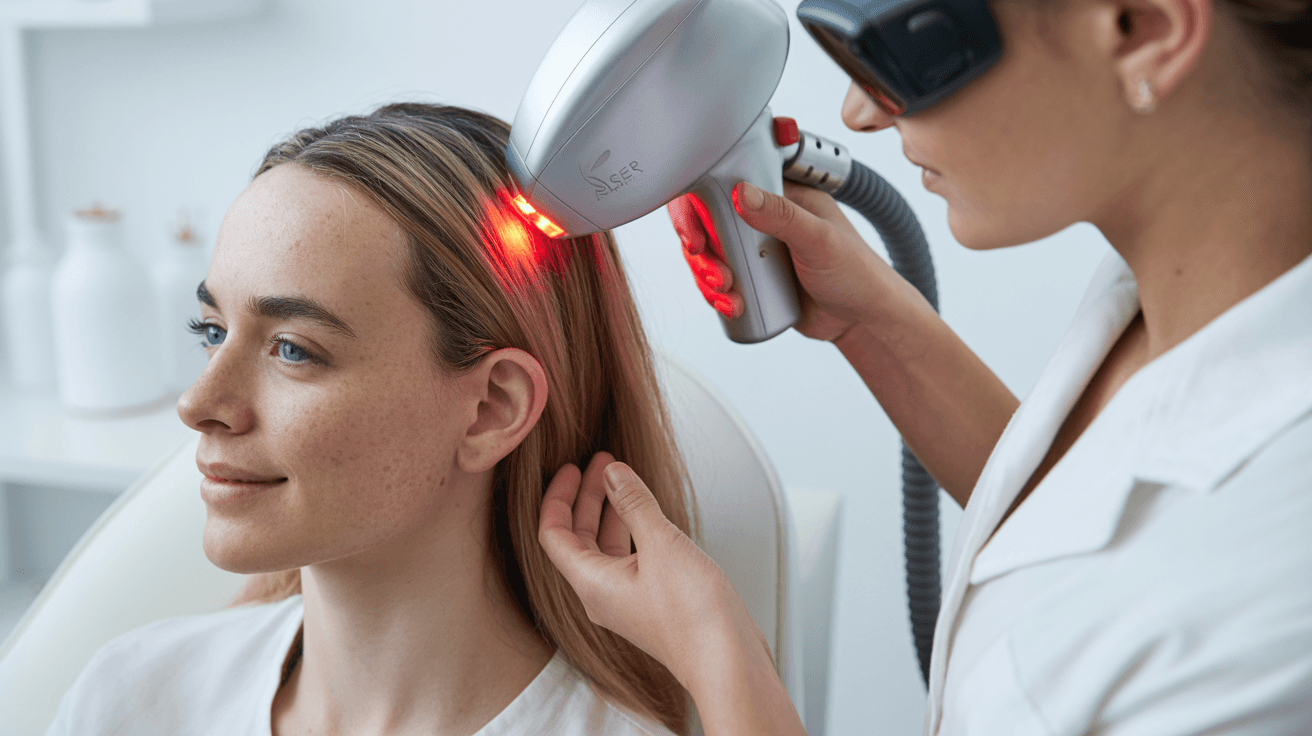
Hair loss affects millions of people in Germany and can lead to significant psychological distress. Thinning hair not only alters physical appearance but often also impacts self-esteem and social interactions. In the Berlin metropolitan area, a growing number of people are seeking effective yet gentle treatment methods for this widespread problem.
Low-level laser therapy (LLLT) has established itself in recent years as a promising non-invasive treatment option. Unlike surgical procedures or drug therapies with potential side effects, laser therapy offers a gentle approach that stimulates the body's own regenerative processes and can promote new hair growth. This modern technology is also gaining increasing importance in the greater Berlin area as an alternative or complement to conventional treatment methods.
What is low-level laser therapy for hair loss?
Low-level laser therapy (LLLT) is a non-invasive procedure in which special red light with a defined wavelength (typically between 630 and 670 nanometers) is directed at the scalp. Unlike surgical lasers, which can cut or ablate tissue, LLLT operates at a low energy density that does not generate heat or damage tissue. Instead, it stimulates natural biological processes at the cellular level.
The method was originally developed in the 1960s and initially used in wound healing and pain therapy. In the 1980s, the Hungarian physician Endre Mester accidentally discovered that low-intensity laser light could stimulate hair growth in mice. Since this groundbreaking discovery, the technology has been continuously developed and optimized.
Today, various types of devices are used in LLLT:
Laser helmets and caps : These are placed on the head and treat the entire scalp evenly.
Laser combs : Handheld devices that emit laser light during combing and allow for flexible application.
Professional laser systems : These are used in specialized clinics such as the AS Clinic in the heart of Berlin and offer precisely controllable, high-quality laser sources for optimal treatment results.
LLLT utilizes the photochemical properties of light to influence cell activity. The specific wavelength of red light is absorbed by the cells and initiates a complex cascade of biological reactions. Scientific studies have shown that this light energy acts directly on the mitochondria – the "powerhouses" of our cells – and increases their activity.
Mechanism of action of laser therapy at the cellular level
The effectiveness of low-level laser therapy for hair loss is based on several well-documented biological mechanisms. At its core is biomodulation – the ability of laser light to influence cellular processes without damaging tissue.
Mitochondrial stimulation
The specific wavelength of red light is absorbed by an enzyme called cytochrome c oxidase, located in the mitochondria. This absorption leads to an increased production of adenosine triphosphate (ATP) – the most important energy carrier in our cells. Studies have shown that LLLT can increase ATP production by up to 150%, providing hair follicle cells with more energy for growth and regeneration.
Improved microcirculation
Another effect of laser therapy is improved blood circulation in the scalp. The laser light promotes the release of nitric oxide, a molecule that leads to the dilation of small blood vessels. This improved microcirculation ensures an optimal supply of oxygen and nutrients to the hair follicles – crucial factors for healthy hair growth.
Activation of dormant hair follicles
Particularly interesting for the treatment of hair loss is LLLT's ability to transition hair follicles from the telogen phase (resting phase) to the active growth phase (anagen phase). This occurs through the stimulation of stem cells in the bulbous area of the hair follicle. These stem cells are responsible for hair regeneration and cyclical growth.
Reduction of DHT and inflammatory processes
In androgenetic alopecia, the most common form of hair loss, the hormone dihydrotestosterone (DHT) plays a central role. It binds to receptors in the hair follicles and leads to their gradual shrinkage (miniaturization). Low-level laser therapy (LLLT) can reduce the effects of DHT on the hair follicles and simultaneously have an anti-inflammatory effect, which is particularly beneficial in inflammatory forms of hair loss.
A meta-analysis of several clinical studies published in 2018 found that LLLT leads to a significant increase in hair density, hair thickness, and overall hair growth. The biological mechanisms of action were summarized as follows:
Biological effect | Effect on hair growth |
|---|---|
Increased ATP production | More energy for hair follicle cells |
Improved microcirculation | Improved nutrient supply to the follicles |
Stem cell activation | Transition of dormant follicles to the growth phase |
Anti-inflammatory effect | Reduction of harmful inflammatory processes |
Modulation of DHT effects | Reduction of follicle miniaturization |
The strength of laser therapy lies in its holistic approach: instead of treating just one symptom, it addresses multiple factors that can contribute to hair loss. This makes it a valuable option in the therapeutic spectrum, especially for patients in the Berlin area who are looking for non-invasive treatment options.
Who is suitable for laser therapy?
Low-level laser therapy is not equally suitable for every form of hair loss. The success of the treatment depends significantly on the underlying cause of the hair loss, the stage of the condition, and individual factors. A thorough diagnosis by a specialist, such as that offered at the AS Clinic in Berlin, is therefore essential to realistically assess the chances of success.
Especially well suited for:
Androgenetic alopecia (hereditary hair loss)
This most common form of hair loss, affecting both men and women, responds particularly well to laser therapy. Studies show that LLLT achieves the best results in cases of mild to moderate hereditary hair loss. Those in the early stages, where hair follicles are still active but their function is impaired, benefit most from the treatment.
Diffuse hair loss
LLLT can also be effective for diffuse hair loss, which is often triggered by stress, nutritional deficiencies, or hormonal changes. The treatment supports the regeneration of hair follicles and can normalize the hair growth cycle. Women in Berlin, in particular, who suffer from hair loss after pregnancy or during menopause, report good results with laser therapy.
Alopecia areata (circular hair loss)
In mild cases of alopecia areata caused by autoimmune reactions, low-level laser therapy (LLLT) can be used as a complementary therapy. The anti-inflammatory properties of the laser light can help modulate the immune response and promote hair growth.
As a preventive measure
More and more people in the greater Berlin area are opting for preventative laser therapy if they have a genetic predisposition or notice the first signs of hair loss. Early intervention can slow down or even stop the progression of hair loss.
Supportive to other treatments
LLLT is ideally suited as a supportive therapy after hair transplants or in combination with topical agents such as minoxidil. It can improve the success rate of transplanted hair follicles and enhance the effectiveness of other treatments.
Less suitable for:
Advanced hair loss
In cases of advanced hair loss where the hair follicles have already completely receded, the effectiveness of laser therapy is limited. In these cases, a combination with other treatment methods or a hair transplant may be a better option.
Scarring alopecia
In cases of scarring hair loss, where the hair follicle tissue is permanently damaged by scarring, LLLT alone cannot achieve sufficient results.
Acute scalp conditions
Laser therapy should be avoided in cases of acute inflammation, infection, or open wounds on the scalp until these conditions have healed.
The decision to undergo laser therapy should always be based on a thorough diagnosis. At the AS Clinic in Berlin, each patient receives individual consultation and examination to develop the optimal treatment strategy. State-of-the-art diagnostic procedures are used to determine the exact cause of hair loss and to assess the activity of the hair follicles.
"The right patient selection is crucial for the success of laser therapy. A precise diagnosis allows us to predict which patients will benefit most from the treatment." – Specialist at AS Clinic Berlin
Procedure of a laser therapy treatment at the AS Clinic
Laser hair loss therapy at the AS Clinic follows a structured, scientifically based protocol that is individually tailored to each patient. The entire process is designed to achieve maximum results with the utmost comfort. Located in the heart of Berlin, the clinic offers a calm and professional environment for treatment.
Initial consultation and diagnosis
The treatment process begins with a detailed initial consultation, during which a specialist from the AS Clinic analyzes your individual hair situation. This includes:
Detailed medical history : recording of medical history, family history and potential triggers of hair loss
Dermatological examination : Assessment of the condition of the scalp and hair follicles
Digital hair analysis : Hair density, hair thickness and growth patterns are precisely documented using state-of-the-art camera systems.
Trichoscopy : Microscopic examination of the scalp to accurately determine the condition of the hair follicles.
Based on this comprehensive analysis, the team of experts will create a personalized treatment plan tailored to your specific situation.
Preparation for treatment
Before the actual laser therapy, the scalp is carefully cleansed to remove any residue from hair care products that could interfere with the effectiveness of the laser light. Patients are asked to wash their hair before the appointment but not to use any styling products.
At AS Clinic, only high-quality medical laser systems certified according to strict European safety standards are used. These systems are calibrated before each treatment to ensure the optimal light intensity and wavelength for each patient.
Performing laser therapy
The actual treatment proceeds as follows:
Positioning : The patient assumes a comfortable position while the laser system is optimally aligned with the areas to be treated.
Protective measures : Special protective goggles are worn to protect the eyes from the laser light.
Treatment : The laser system is activated and emits light of a specific wavelength onto the scalp.
Treatment duration : A typical session lasts between 20 and 30 minutes, depending on the size of the area to be treated.
Throughout the entire treatment, the patient is supervised by an experienced physician or therapist. Laser therapy is completely painless – many patients describe only a slight sensation of warmth on the scalp, which is perceived as pleasant.
Aftercare and treatment plan
There is no downtime after the treatment – patients can immediately return to their normal activities. The AS Clinic team provides detailed scalp care instructions and often recommends complementary measures such as:
Special shampoos to support hair growth
Dietary supplements to optimize hair follicle nutrition
Tips for a hair-sensitive lifestyle
For optimal results, laser therapy at the AS Clinic follows a structured schedule:
phase | frequency | Length of time | Expectations |
|---|---|---|---|
Intensive phase | 1-2 sessions per week | 8-12 weeks | Activation of hair follicles, slowing of hair loss |
Stabilization phase | One session every two weeks | 12 weeks | Increase in hair density, first regrowth of new hair |
Maintenance phase | 1 session per month | Ongoing | Maintaining and optimizing results |
Progress monitoring and adjustment
An important aspect of treatment at the AS Clinic is the regular documentation and evaluation of therapy progress:
Standardized control photos are taken after every 4th to 6th session.
The digital hair analysis is repeated to measure objective changes.
The treatment plan will be adjusted as needed to achieve optimal results.
“Our patients particularly appreciate the structured approach and the regular progress checks. The objective documentation of improvements is a motivating factor for many to consistently continue the treatment,” explains a member of the treatment team at the AS Clinic in Berlin-Mitte.
The first visible results typically appear after 8-12 weeks of regular treatment. The full effect develops after about 6-8 months, although individual differences may exist depending on the initial situation and the cause of the hair loss.
Scientific studies on the effectiveness of laser therapy
Low-level laser therapy for hair loss has gained increasing scientific recognition in recent years. Numerous clinical studies and meta-analyses have investigated the effectiveness of this treatment method and documented predominantly positive results. As an evidence-based treatment center in Berlin, the AS Clinic places great emphasis on scientifically sound therapeutic approaches.
Clinical trials and their results
One of the most significant studies was published in 2014 in the American Journal of Clinical Dermatology. This double-blind, placebo-controlled study examined 146 male and 188 female participants with androgenetic alopecia. The results showed:
A significant increase in hair density of an average of 19 hairs per square centimeter in men.
An improvement of an average of 20.2 hairs per square centimeter was observed in female participants.
A significant improvement in hair thickness and hair growth in both sexes.
Another study published in the Journal of Dermatological Treatment (2019) investigated the efficacy of LLLT in 100 patients with early to moderate hereditary hair loss over a period of 24 weeks. The results were impressive:
85% of participants showed a reduction in active hair loss.
65% reported a moderate to significant improvement in hair growth.
A measurable increase in hair density was observed in 72% of participants.
Meta-analyses confirm the effectiveness
A comprehensive meta-analysis from 2018, which evaluated eleven randomized controlled trials with a total of 680 patients, concluded that LLLT resulted in a statistically significant improvement in hair thickness, hair density, and patient satisfaction compared to control groups. The analysis found:
"Low-level laser therapy represents a safe and effective treatment option for men and women with androgenetic alopecia."
Long-term studies and sustainability of results
Long-term data on the effectiveness of laser therapy are of particular interest to patients from Berlin and the surrounding area. A study published in 2017 examined the results of 72 patients over a period of three years and concluded:
93% of patients who continued treatment regularly maintained their improved results.
In 84% of cases, a further gradual improvement was observed during the course of continued treatment.
The therapy discontinuation rate was comparatively low at 12%, indicating high patient satisfaction.
Individual response to therapy
Scientific studies have shown that the response to LLLT depends on various factors:
Influencing factor | Impact on treatment outcome |
|---|---|
Old | Younger patients tend to respond better. |
Stage of hair loss | Early to middle stages show better results |
Hair color | Dark hair absorbs light energy more effectively. |
Regularity of application | Consistent treatment significantly improves the results. |
Combination with other therapies | Synergistic effects are possible when used in combination. |
The individual differences in treatment response underscore the importance of expert advice and personalized treatment planning, such as that offered at the AS Clinic in Berlin.
Advantages of laser therapy compared to other treatment methods
Low-level laser therapy offers numerous advantages over other hair loss treatment options, making it particularly attractive for patients in Berlin and the surrounding area. As a non-invasive, painless method with minimal side effects, it has established itself as a valuable alternative or complement to conventional therapies.
Non-invasive and painless
Unlike surgical procedures such as hair transplants, laser therapy is completely non-invasive. No incisions or punctures are made, and no scars are left behind. The treatment is painless and requires neither local anesthesia nor sedation. This makes it particularly suitable for patients who are averse to surgical procedures or who are medically ineligible for them.
No significant side effects
Unlike drug therapies such as finasteride, which can cause systemic side effects like sexual dysfunction or depression, or minoxidil, which frequently leads to skin irritation, the side effects of laser therapy are minimal to nonexistent. In rare cases, mild itching or temporary reddening of the scalp may occur, but this subsides quickly.
No downtime
A major advantage for working patients in bustling Berlin is the lack of downtime after treatment. After a hair transplant, patients often have to pause for several days or even weeks and take special precautions. Laser therapy, on the other hand, allows them to return to their normal daily routine immediately after treatment – a crucial advantage for people with busy schedules.
Natural results
LLLT promotes the growth of the patient's own hair, resulting in a completely natural-looking outcome. The treated hairs are indistinguishable from untreated hairs in structure, growth direction, or color, as the treatment involves the reactivation of the body's own hair follicles.
Universal applicability
Laser therapy can be used on almost all patients, regardless of gender, skin type, or hair color. This contrasts with certain drug treatments, which, for example, may be contraindicated for women of childbearing age or not recommended for certain skin types.
Compatibility with other treatments
A particular advantage of LLLT is its excellent compatibility with other treatment methods. The synergistic effects can significantly improve overall results.
With drug therapies : Laser therapy can increase the effectiveness of minoxidil and often allows for a reduction in the finasteride dosage.
After hair transplants : LLLT promotes the healing of transplanted follicles and can improve the survival rate of the transplanted hairs.
With PRP (Platelet-Rich Plasma) : The combination of growth factors from the patient's own blood and the stimulating effect of laser light shows particularly promising results.
Cost-effectiveness in the long term
Although the initial costs for a professional laser therapy series can be considerable, in the long run it is often more cost-effective than continuous drug therapies or repeated surgical procedures. The AS Clinic in Berlin offers transparent cost models that take this long-term perspective into account.
AS Clinic: Your specialist for laser therapy in Berlin
AS Clinic has established itself as one of the leading centers for laser therapies in Berlin and the surrounding area. With a specialized team and state-of-the-art technology, we offer individual solutions for every patient, adhering to the highest standards of the German Society for Aesthetic Botulinum Toxin Therapy .
Our expertise
The AS Clinic team has extensive experience in the field of hair transplantation with a special focus on laser therapy:
More than 10 years of experience in performing laser therapy, hair and eyebrow transplantation
Specializing in natural-looking results
Individual adaptation of the treatment to the specific needs of each patient
Continuous professional development and implementation of the latest technologies
Our methods
We rely on scientifically sound and state-of-the-art methods:
Advanced FUE technique : Minimally invasive extraction of individual follicular units using state-of-the-art micro-instruments
DHI method : Direct implantation for precise placement and natural growth direction.
CMDHi procedure : Our innovative combination of micro-FUE and DHI for optimal results
Computer-aided planning : Precise analysis and planning
Comprehensive service
Our patients benefit from a comprehensive, worry-free package:
Comprehensive initial consultation : Individual analysis and realistic assessment of the possibilities
Transparent pricing : No hidden costs or unexpected additional fees.
Structured aftercare : Close monitoring after the procedure with several check-up appointments.
Emergency hotline : Direct contact for questions or concerns after the procedure
Aftercare set : Special care products for optimal healing
Central location in Berlin
AS Clinic is centrally located in Berlin and easily accessible:
Good public transport connections
Parking spaces in the immediate vicinity
Modern and discreet premises
Pleasant and relaxed atmosphere