Surgery · Blepharoplasty
Eyelid surgery in Berlin – upper and lower blepharoplasty at AS Clinic
Hooded lids, excess eyelid skin or pronounced eye bags can make the eye area look tired, heavy or older, even when you feel awake and rested. Surgical eyelid correction – medically, blepharoplasty – can reduce excess skin and reorganise the natural contours of the upper or lower lids.
At AS Clinic Berlin on Kurfürstendamm, eyelid surgery is planned individually according to the anatomy, the excess skin, the distribution of fat, the position of the eyebrows and the stability of the lower lid. The aim is not an artificially tight or altered gaze, but an eye area that looks more rested and still suits your face.
In an upper blepharoplasty, excess skin is removed through an incision in or along the natural lid crease. In a lower blepharoplasty we assess, depending on the findings, whether skin, fat pads and other structures need correcting. Fat is not removed as a matter of course: where it makes anatomical sense, fat pads can be preserved and redistributed to avoid unnecessary hollowing.
What is eyelid surgery?
Eyelid surgery is a surgical procedure on the upper and/or lower lids. The aim is to correct anatomically troublesome excess skin and — depending on the findings — fat or supporting tissue, so that the eye area stays functionally and aesthetically balanced. The operation is also called blepharoplasty or eyelid correction. Upper and lower blepharoplasty are two different procedures, however, with different anatomy, incisions and risk profiles.
Eyelid surgery in Berlin – the key facts at a glance
- Medical term
- Blepharoplasty / eyelid correction
- Upper lid
- Correction of excess skin and, where required, deeper structures
- Lower lid
- Treatment of excess skin, eye bags and fat distribution according to the findings
- Duration of surgery
- Approx. 45–120 minutes, depending on the extent
- Anaesthesia
- Determined individually
- Incision
- In the natural crease at the upper lid; at the lower lid depending on technique and findings
- Presentable again
- Often after about 10–14 days
- Result
- Increasingly visible as swelling subsides; scars mature over months
- Location
- AS Clinic, Kurfürstendamm 102, 10711 Berlin-Charlottenburg
- Consultation
- Individual surgical assessment before the procedure
What can eyelid surgery change?
Eyelid surgery cannot resolve every form of dark circle, brow descent, ptosis or skin ageing. The precise cause of what you see therefore matters decisively before surgery. What it can address:
- Reducing excess skin on the upper lid
- Correcting hooded lids
- Softening a heavy or tired expression of the upper lids
- Treating eye bags or protruding fat pads on the lower lid
- Reducing excess lower-lid skin
- Making the transition between lower lid and cheek more harmonious, where the anatomy suits
- Taking slight differences between the sides into account during planning
More on this: Surgical treatments in Berlin
Upper blepharoplasty in Berlin
In an upper blepharoplasty, excess skin on the upper eyelid is removed through an individually planned incision in the natural lid crease. Depending on the findings, fat pads or other structures can additionally be corrected conservatively. Typical reasons for an upper blepharoplasty are:
- Hooded lids
- Excess skin above the natural lid crease
- A gaze that looks heavy or tired
- Asymmetrically pronounced lid skin
- Functional impairment where excess skin is pronounced
How is the incision line planned on the upper lid?
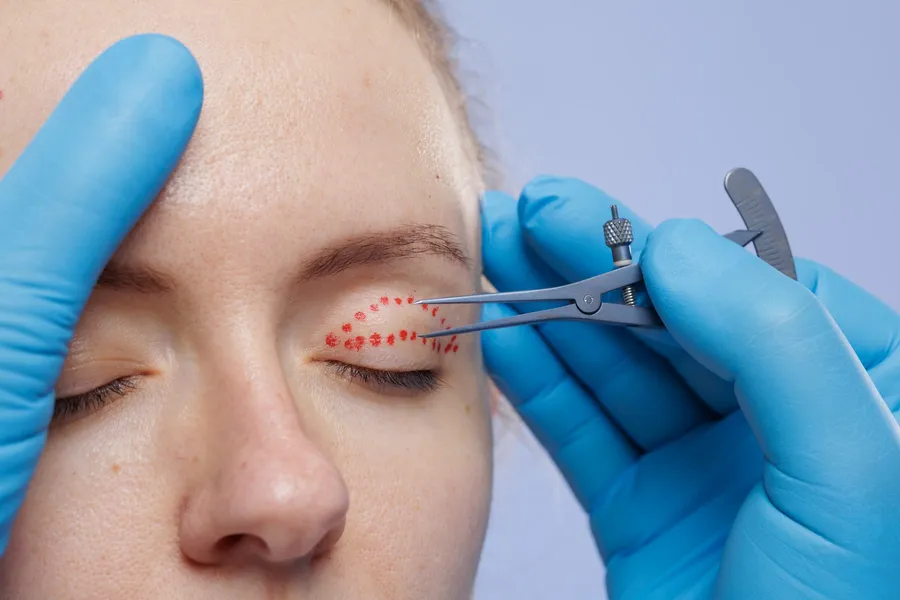
The incision is planned to lie in the natural upper lid crease as far as possible. Once healing is complete, the scar can then largely sit within the lid fold when the eye is open. Before the procedure we mark how much skin can be removed without endangering safe lid closure. Removing too much skin can lead to tightness, a dry eye or difficulty closing the eye fully, and is therefore avoided.
Lower blepharoplasty in Berlin
A lower blepharoplasty mainly addresses eye bags, protruding fat, excess skin and certain age-related changes of the lower lid. The technique is determined more than at the upper lid by the distribution of fat, skin quality and the stability of the lower lid. Possible goals are:
- Reducing eye bags
- Repositioning or specifically correcting protruding fat pads
- Reducing excess lower-lid skin
- Making the transition between lower lid and cheek more harmonious
- Smoothing the lower-lid contour where the anatomy suits
Are lower-lid fat pads removed or redistributed?
That depends on your individual anatomy. Modern lower-lid concepts often try not to remove fat wholesale, but to preserve and redistribute it where the starting point suits, so that no unnecessary hollowing develops under the eye. For some people a targeted reduction makes sense, for others a repositioning. Which strategy is chosen depends on the eye bags, the tear trough, the midface and the excess skin.
Where does the incision run in a lower blepharoplasty?
Depending on the findings, the incision can be made just below the lashes or through the inside of the lower lid. Which technique is suitable depends among other things on whether excess skin also has to be treated. A transconjunctival technique through the inside of the lower lid is mainly an option where fat pads are to be treated and there is little external excess skin; with marked skin laxity an external incision may be necessary.
Hooded lid, ptosis or a descended brow – what is the difference?
Not every low-looking upper lid is a hooded lid. Excess skin, a true lid ptosis and a descended eyebrow are different findings and can require different treatments. A pure skin removal can be insufficient if the actual cause is a different one. Before surgery it should therefore be established:
- Is excess upper-lid skin the main issue?
- Does the lid margin itself sit lower than usual?
- Is a descended eyebrow pushing additional tissue onto the upper lid?
- Are there differences between the sides?
- Are there dry eyes, previous eye surgery or other ophthalmological factors?
When does the eyebrow position matter for eyelid surgery?
A low-sitting eyebrow can simulate or amplify excess skin on the upper lid. The brow position should therefore be assessed as part of any upper-lid planning. If only lid skin is removed although the essential finding comes from a descended brow, the result can be less than expected. Whether an additional or alternative treatment makes sense is discussed individually.
More on this: Botox in Berlin
Eye bags or dark circles – what can a lower blepharoplasty treat?
A lower blepharoplasty can mainly treat structural eye bags, protruding fat and excess skin. Dark circles, by contrast, can also be caused by pigmentation, visible vessels, thin skin or shadow, and do not automatically disappear with surgery. Not every dark under-eye region is a surgical problem. Before treatment we therefore distinguish between:
- Protruding fat tissue
- The tear trough, or the transition in volume
- Pigmentation
- Vascular discolouration
- Excess skin
- A tendency to swelling
More on this: Eye mesotherapy in Berlin
What makes an eyelid result look natural?
A natural result comes from conservative tissue removal, preserving important structures and an incision that suits your individual anatomy. The aim is a more rested eye area – not a visibly "operated" gaze. Particularly important are:
- Keeping enough skin for complete lid closure
- Not removing fat entirely without need
- Taking the eyebrow position and lid margin into account
- Assessing lower-lid stability before lower-lid surgery
- Planning the right and left sides individually
- Placing the scar in natural creases or inconspicuous areas
Can the upper and lower lids be treated at the same time?
Upper and lower blepharoplasty can be combined in one session where the starting point suits. Whether a combination makes sense depends on the extent, the anaesthesia, your state of health and your individual anatomy. A combined operation takes longer and can involve more swelling than an isolated upper blepharoplasty, so the treatment plan is determined individually.
How eyelid surgery works at AS Clinic Berlin
-
Surgical consultation
We start by establishing what bothers you about your eye area and whether the finding is caused by upper-lid skin, lower-lid skin, fat pads, the eyebrow position, the tear trough or another structure. Pre-existing conditions, medication, dry eyes, previous eye surgery and your expectations are discussed.
-
Examination and photo documentation
The upper and lower lids are assessed at rest and with the eyes open and closed. Excess skin, symmetry, brow position, lid margin position and lower-lid stability can all be taken into account. Before photos serve the planning and the follow-up.
-
Individual surgical planning
We determine whether the upper lid, lower lid or both regions are treated, how the incision runs and whether fat should be preserved, repositioned or specifically reduced. The appropriate form of anaesthesia is also set out in the individual surgical plan.
-
Marking before the procedure
The relevant skin and incision lines are marked before surgery. At the upper lid the planning follows the natural lid crease and the need to keep enough tissue for safe lid closure.
-
Surgery
Depending on the extent, the procedure takes about 45 to 120 minutes. Excess skin is removed in a controlled way; fat pads and other structures are corrected only as far as the planned result requires.
-
Wound closure and immediate aftercare
The fine skin incisions are closed. Cooling, rest and protecting the eye area are then the priority. The further review appointments follow the procedure and how healing progresses.
How does healing after eyelid surgery go?
Swelling and bruising in the first days after eyelid surgery are normal and can increase at first before slowly subsiding. Many patients feel presentable again after about 10–14 days; the exact course is individual. The eye area typically changes in several phases — swelling, tightness and bruising are most pronounced in the first days; visible reactions subside step by step over the first one to two weeks; the lid contour becomes more natural over the following weeks as residual swelling continues to decrease; and scars become softer and less noticeable over several months. The final result should not be judged in the first days.
When are the sutures removed?
When sutures are removed depends on the incision, the suture material used and how healing progresses. The specific review and suture plan is determined individually after the procedure.
When will I be presentable again after eyelid surgery?
For visible swelling and bruising, about 10–14 days should often be allowed for. Some people look inconspicuous sooner, others need longer. If you are planning an important work commitment, a wedding, a photoshoot or a trip, allow enough time after the operation.
When can I work again?
With mainly seated work, returning can often be possible sooner than with physically demanding work. What matters is the procedure, the swelling, visual comfort, your professional requirements and how healing progresses. A specific period off work should be discussed in your personal surgical plan.
When can I exercise again after eyelid surgery?
Intense physical exertion should be avoided in the early healing phase, because a rise in blood pressure and circulation can promote bleeding and swelling. The exact timing for exercise is set according to the procedure. Light movement can be possible sooner than strength training, intense endurance sport, saunas or swimming.
When can I wear make-up and contact lenses again?
Make-up should only be applied to the eye region once the wounds are sufficiently closed and your individual aftercare allows it; fresh incisions should not be irritated or covered unnecessarily. Contact lenses can stress the lid when being inserted and removed, so when they can be worn again depends on healing, swelling and the ocular surface and is determined individually.
When do you see the result of eyelid surgery?
A first change is visible immediately, but is masked in the early days by swelling and bruising. The result becomes increasingly assessable over several weeks; scar maturation takes considerably longer. With lower-lid surgery the final contour can develop more slowly than after a simple upper blepharoplasty.
How long does eyelid surgery last?
The skin tissue that has been removed does not simply grow back. The natural ageing of the skin, eyebrows, lids and midface continues, however. Eyelid surgery is therefore long-lasting, but not a permanent pause on ageing. How long the result is subjectively perceived as unchanged depends on genetics, tissue quality, sun exposure, lifestyle and the initial findings.
Eyelid lift without surgery – can Botox, laser or plasma replace an operation?
Non-surgical procedures can play a role with selected mild skin or expression changes, but they do not remove pronounced excess skin the way a surgical blepharoplasty does. Botulinum toxin acts on muscle activity, not on excess lid skin. Laser, radiofrequency or other skin-tightening procedures can affect skin quality, but with a marked hooded lid or pronounced eye bags they do not automatically replace an operation.
What does eyelid surgery cost, and does insurance cover it?
The cost depends on whether the upper lid, lower lid or both regions are treated, which technique is required and what anaesthetic and surgical planning is necessary. A sound price can therefore only be set after a personal examination; you receive an individual treatment and cost plan before the procedure. A purely aesthetic eyelid correction is generally paid privately. With a pronounced functional impairment a medical assessment may be required; whether costs can be covered is decided by the insurer according to its own criteria, so possible cover should be clarified with them before the procedure.
Risks and possible side effects of eyelid surgery
Eyelid surgery is a surgical procedure and not free of risk. Common temporary reactions are swelling, bruising, tightness and temporary dryness. Less often, functionally relevant complications can occur. The individual explanation of risks takes place before the operation and follows the upper lid, lower lid, pre-existing conditions and the specific technique. Possible risks include:
- Swelling and bruising
- Bleeding or haematoma
- Infection
- Delayed wound healing
- Noticeable or irregular scars
- Temporary numbness or altered sensation
- Asymmetry
- Under- or overcorrection
- Temporarily dry, irritated or watering eyes
- Temporary difficulty closing the eye completely
- Lid malposition such as ectropion or retraction, particularly at the lower lid
- Chemosis, or swelling of the conjunctiva
- The need for a corrective procedure
- Very rarely, serious bleeding affecting vision
Which symptoms after eyelid surgery are a warning sign?
A sudden marked deterioration in vision, severe or rapidly increasing pain, very pronounced one-sided swelling, persistent bleeding, double vision or other acute visual problems must be assessed medically at once. Symptoms like these should not be left until the next regular review appointment.
Eyelid surgery with dry eyes
Existing dry eyes matter for surgical planning, because eyelid surgery can temporarily worsen the symptoms. Dry eyes, problems with contact lenses and previous eye conditions should therefore be mentioned at the consultation. With pronounced symptoms, an additional ophthalmological assessment before the procedure can make sense.
Who may eyelid surgery be suitable for?
Eyelid surgery may be an option for adults with a clearly defined skin, fat or tissue finding on the upper or lower lids, where their state of health permits a surgical procedure. Among the things taken into account are:
- The extent of the excess skin
- The distribution of fat at the upper and lower lid
- The lid margin position and lower-lid stability
- The eyebrow position
- Dry eyes or other eye complaints
- Previous eye or facial procedures
- Pre-existing conditions and medication
- Smoking and wound-healing risks
- Realistic expectations
When should eyelid surgery not be carried out, or only later?
With acute eye or skin infections, undiagnosed eye conditions or certain health risk factors, an operation can be unsuitable or postponed. Clotting problems, certain medicines, poorly controlled conditions or pronounced dry eyes can also affect the planning. Prescribed medicines must never be paused or stopped on your own initiative for an operation.
Eyelid surgery for women and men
Upper and lower blepharoplasty can be carried out for women and men. What matters is the anatomy, the excess skin and the expression you want – not a rigid gender-specific surgical template. At the upper lid in particular, the natural shape of the lid crease and the brow position should be preserved so that your individual expression is not changed unnecessarily.
Before-and-after with eyelid surgery – when is a comparison meaningful?
Before-and-after images should only be assessed after enough healing time. Early photos can give a distorted impression through swelling, bruising, lighting and expression. For sound documentation, comparable perspective, lighting, head position and expression all matter. Another person's result cannot be transferred to your own anatomy, however.
Eyelid surgery on Kurfürstendamm in Berlin-Charlottenburg
AS Clinic Berlin is located on Kurfürstendamm in Berlin-Charlottenburg. If you are looking for eyelid surgery in Berlin, an upper blepharoplasty for hooded lids or a lower blepharoplasty for eye bags, the first step is to establish which anatomical finding is actually the priority.
AS ClinicKurfürstendamm 102
10711 Berlin · Charlottenburg
+49 179 390 2489
Mon – Fri · 10:00 – 19:00
Saturday · 10:00 – 16:00
Sunday · Closed
More on this: AS Clinic Berlin on Kurfürstendamm — location and directions
Why choose AS Clinic for eyelid surgery in Berlin?
Upper and lower lid analysed separately
Upper and lower blepharoplasty are not identical procedures. Excess skin, fat distribution, brow position and lower-lid stability are each assessed separately.
Preserving fat where it makes sense
At the lower lid in particular, fat is not removed entirely as a matter of course. Where it suits the anatomy, preserving or redistributing it can help avoid a hollowed appearance.
The natural lid crease as the guide
The upper-lid incision follows the natural lid crease. The aim is a scar that is as inconspicuous as possible while the natural lid shape is preserved.
No surgery to a standard template
How much skin is removed and how deeper structures are treated is planned individually. The tightest possible result is not automatically the better one.
Realistic recovery time
The visible healing phase is planned for openly. About 10–14 days should often be allowed for social commitments, even though full tissue and scar maturation takes considerably longer.
Medical qualification
Nader Farahwaschy – specialist in surgery. Medical licence since 2004; specialist recognition in surgery from the Berlin Medical Association since 2011. Individual surgical suitability is assessed at the personal consultation.
Questions
Frequently asked questions about eyelid surgery in Berlin
Twenty answers written by our physicians.
What is eyelid surgery?
What is an upper blepharoplasty?
What is a lower blepharoplasty?
What is the difference between a hooded lid and ptosis?
Can a descended eyebrow look like a hooded lid?
How long does eyelid surgery take?
Which anaesthesia is used?
Does eyelid surgery hurt?
How long will I be swollen after eyelid surgery?
When will I be presentable again?
When can I work again after eyelid surgery?
When can I exercise again?
When can I wear make-up after the operation?
When can I wear contact lenses again?
Are lower-lid fat pads removed?
Where is the scar after an upper blepharoplasty?
Where is the scar after a lower blepharoplasty?
Can the upper and lower lids be operated on together?
Can eyelid surgery remove dark circles?
Can eyelid surgery remove eye bags?
Is an eyelid lift possible without surgery?
How long does eyelid surgery last?
Can eyelid surgery cause dry eyes?
What are the risks of an upper blepharoplasty?
What are the risks of a lower blepharoplasty?
Which warning signs matter after the operation?
Can eyelid surgery correct asymmetric eyes?
From what age does eyelid surgery make sense?
Is eyelid surgery suitable for men?
What does eyelid surgery cost at AS Clinic Berlin?
Does insurance cover an upper blepharoplasty?
Where can I have eyelid surgery in Berlin?
Related treatments at AS Clinic Berlin
Direct Lift
Direct lift in Berlin: a surgical option for the brow and upper facial frame.
Eyes Mesotherapy
Eye mesotherapy in Berlin: skin quality around the eyes, not excess skin.
Botox
Botox in Berlin: works on muscle activity, not on excess lid skin.
Cheeks Filler
Cheek filler in Berlin: supports the midface below the lower lid.
Skin Booster
Skin Booster in Berlin: injectable hydration for skin quality.
Profhilo
Profhilo in Berlin: hyaluronic acid bio-remodelling for skin quality.
Appointments
Request a surgical consultation for eyelid surgery in Berlin
Are hooded lids, excess lid skin or eye bags bothering you, and would you like to know whether an upper blepharoplasty, a lower blepharoplasty or a combined eyelid correction suits your starting point? Arrange a personal consultation at AS Clinic Berlin on Kurfürstendamm. We discuss the lid skin, the fat distribution, the brow position, lower-lid stability, the possible incision, the healing time, the risks and your individual surgical plan.